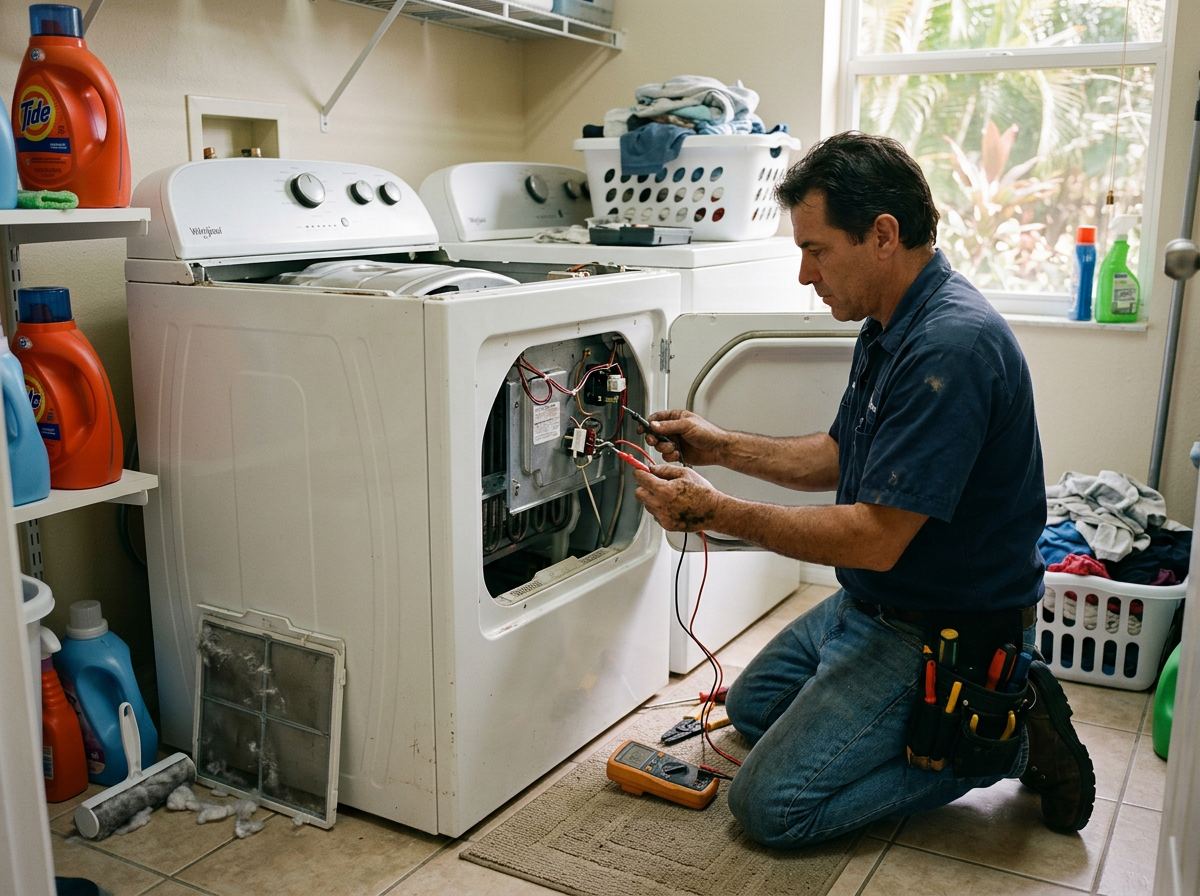
Clermont homeowners often notice a dryer that tumbles yet stays cold after the first load of the day. In block-stucco homes on slabs near Downtown Clermont and the Historic District, long roof-vented runs trap lint and allow garage humidity to build, tripping the thermal fuse or high-limit thermostat. We start by checking the 240-volt outlet and breaker, then test the heating element, thermistor, and cycling thermostat with a multimeter while the machine is still in place. On the same machines we also see electric dryer faults, loads that take too long to dry and dryer vent problems.
Restricted airflow from crushed transition hoses or clogged roof vent caps is common in two-story Lake Highlands properties and vacation rentals with extended vent paths. Our techs pull the drum to inspect drive belt tension, idler pulley, and rear bearing wear that can mask heat issues, then clear lint buildup and verify moisture sensor bars are clean. In the humid subtropical summers, we also check door switches and start switches that fail from repeated heat cycles.
For mostly electric dryers in condos and townhomes, we isolate control board error codes and test flame sensor and igniter components only on the few gas units present. After replacing the faulty part we reassemble, run a timed cycle, and confirm even heat across the drum. This approach handles the long vent runs and slab foundation settling typical throughout Lake County without removing the appliance from the laundry closet.
Technician insight
In Clermont the thing that catches most people out with Dryer Not Heating is two-story block-stucco homes with roof-vented runs that stretch across the attic; the extra length plus summer humidity packs lint against the thermal fuse faster than in single-story garages, and homeowners keep resetting it instead of clearing the vent cap.
Lake Highlands Two-Story Home
A homeowner in a two-story block-stucco house near Lake Highlands reported the dryer tumbling with no heat after three loads. We found the thermal fuse open from a partially crushed transition hose and heavy lint at the roof vent cap. After replacing the fuse, clearing the vent path, and verifying element resistance we ran three full cycles that produced steady heat.
Dryer Not Heating Services We Offer
✓Heating Element Replacement
We remove the old coil, test resistance, and install a new element matched to the model while confirming the high-limit thermostat has not failed from restricted vent airflow.
✓Thermal Fuse and Thermostat Testing
Using live readings we check the thermal fuse, high-limit thermostat, and cycling thermostat for continuity before any disassembly in garage laundry rooms.
✓Vent Restriction Clearing
We disconnect and clear crushed hoses, long roof runs, and roof vent caps common in two-story Clermont homes to restore proper exhaust and prevent repeat fuse trips.
✓Moisture Sensor Bar Cleaning
Oxidized sensor bars are cleaned or replaced so the dryer recognizes load dryness and does not shut off heat prematurely in humid Central Florida conditions.
✓Stacked Unit Component Access
In condos and townhomes we safely separate stacked laundry centers to reach the heating element and thermostats without damaging surrounding cabinetry.
How it works
- 1
On-Site Symptom Verification
We run the dryer through a heat cycle, note error codes, and measure voltage at the outlet while checking for obvious vent restrictions outside the home.
- 2
Targeted Part Testing
The drum is removed only after initial checks; we test the heating element, thermostats, thermistor, and sensors with a multimeter for precise failure identification.
- 3
Component Replacement
Failed parts are swapped using model-specific components, lint is cleared from the housing, and vent connections are resealed to match the original run length.
- 4
Cycle Validation
We reassemble, run multiple timed loads, and confirm consistent heat output and proper shutdown before leaving the residence.