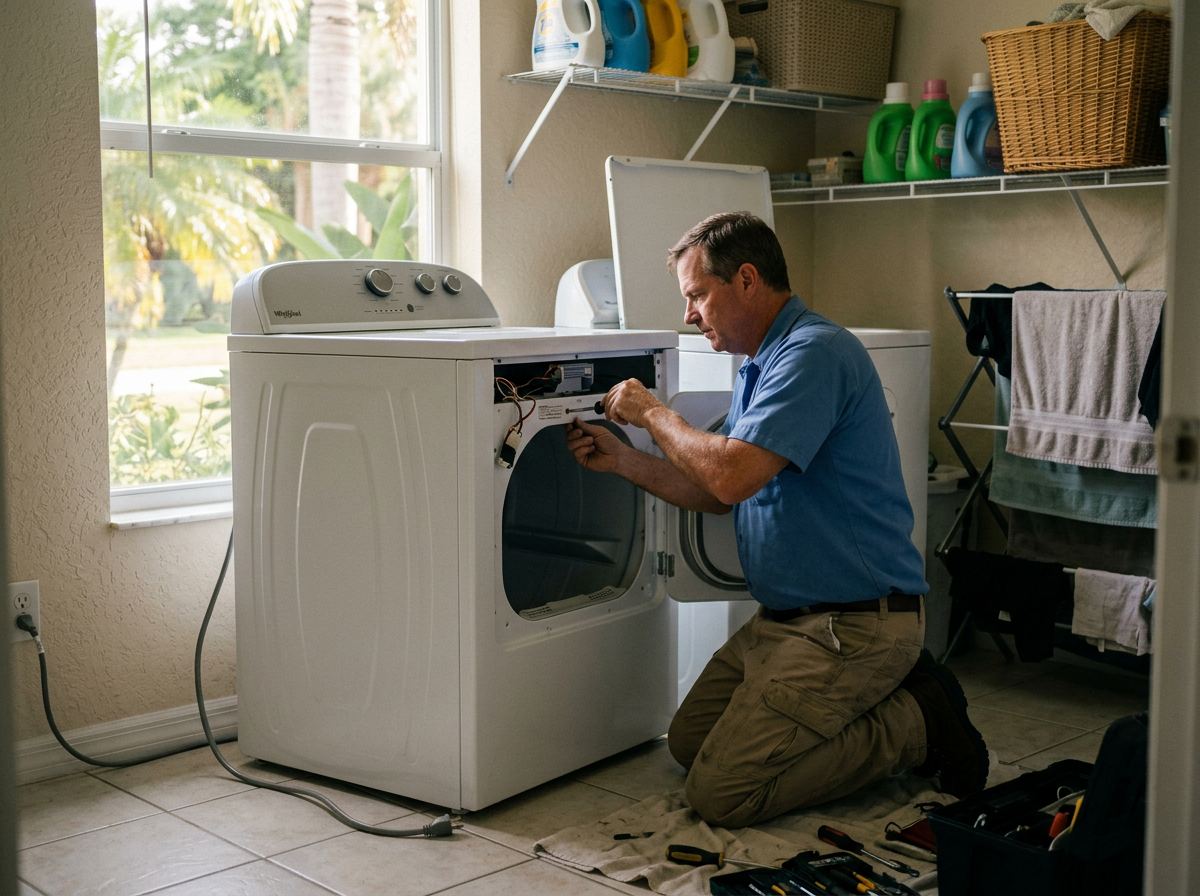
Dryers that stop heating mid-cycle or take multiple runs to finish a load often trace back to the heating element burning out or the thermal fuse tripping from restricted airflow. In block-stucco homes on slabs throughout Clermont, technicians check the high-limit and cycling thermostats along with the thermistor for accurate temperature readings before replacing any part. Moisture sensor bars coated with residue from repeated loads also cause the machine to shut down early even when clothes remain damp. If the symptoms do not quite match, our pages on a dryer that runs but does not heat, a dryer that will not start and stacked washer and dryer units cover the closest cases.
Testing starts with verifying the 240-volt outlet and breaker, then moves to the door switch and start switch for proper signal to the control board. Technicians clear lint build-up inside the drum area and inspect the drive belt, idler pulley, and drum rollers for wear that creates noise or stops rotation. Central Florida's humid subtropical climate combined with long roof-vented runs in two-story homes increases the chance of crushed transition hoses or clogged roof vent caps that force the unit to overheat.
Garage laundry placements common in Clermont expose units to extra humidity that accelerates corrosion on internal components while vacation rental stacked laundry centers demand tight clearance checks. After isolating the fault, replacement focuses on the exact failed part such as the motor or rear bearing rather than full assembly swaps. This approach restores function without unnecessary work on the surrounding cabinet or wiring harness.
Technician insight
In Clermont the thing that catches most people out with electric dryer repair is the long roof-vented runs in two-story block homes. Homeowners often overlook how a partially blocked roof vent cap from summer humidity and pollen forces the thermal fuse to trip repeatedly. Once that vent path is cleared the same dryer usually stops shutting down on every load.
Two-Story Home With Roof Vent Run
The dryer ran but produced no heat after several months of normal use. Inspection found a clogged roof vent cap combined with a failed heating element. The element was replaced and the vent line cleared of lint. The unit now completes cycles without tripping the thermal fuse.
Electric Dryer Repair Services We Offer
✓Heating Element Replacement
Restores consistent heat output by swapping the failed element while confirming thermostat and thermistor function remain accurate for Lake County loads.
✓Thermal Fuse and Thermostat Service
Diagnoses and replaces tripped fuses or faulty high-limit and cycling thermostats that shut down cycles prematurely in humid garage environments.
✓Restricted Vent and Lint Clearance
Removes lint build-up and corrects long vent runs or crushed hoses common in two-story Clermont homes to prevent overheating and extend component life.
✓Drum Roller and Belt Repair
Replaces worn drum rollers, glides, idler pulley, and drive belt to eliminate squealing and restore smooth rotation in daily-use electric dryers.
✓Moisture Sensor and Control Diagnostics
Cleans sensor bars and tests the control board plus door switch to fix false error codes that interrupt cycles in stacked condo units.
How it works
- 1
On-Site Symptom Review
Technician listens to the reported issue and runs the dryer through its cycle to observe heat, drum movement, and any error codes.
- 2
Component Isolation Testing
Multimeter checks are performed on the heating element, thermal fuse, thermostats, and motor while inspecting the vent path for restrictions.
- 3
Targeted Part Replacement
Only the confirmed faulty part such as the element or belt assembly is replaced using components matched to the specific model.
- 4
Final Function Verification
The dryer completes a full test cycle with vent airflow measured to confirm safe operation before leaving the home.